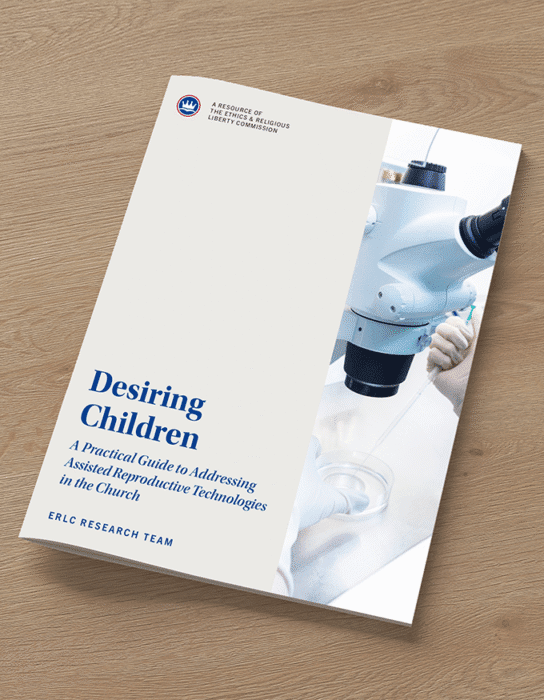
Desiring Children: A Practical Guide to Addressing Assisted Reproductive Technologies in the Church
This practical guide to addressing reproductive technologies is to assist Southern Baptist churches in navigating this complex and emotionally fraught issue from an explicitly Christian, pro-life framework.
"The goal is to help local churches, pastors, ministry leaders, and other Christians navigate the heart-wrenching difficulties of infertility in light of the technologies available to couples who desire to have children. We pray that the guide will help our churches think through the ethics of ARTs, shepherd and care for families affected by infertility, and respond lovingly with the hope of the gospel."
RaShan Frost, ERLC director of research and senior fellow
This practical guide to addressing assisted reproductive technologies is to assist Southern Baptist churches in navigating this complex and emotionally fraught issue from an explicitly Christian, pro-life framework.
Children are a gift from God. The desire to have children of one’s own is a good and natural desire that recognizes the gift sons and daughters are to our families and our societies. The family is both a blessing from God and the building block of a healthy society (BF&M 2000, Article XVIII).
The family is both a blessing from God and the building block of a healthy society.
Unfortunately, due to the fall in Genesis 3, the desire to have children is often complicated by the devastating reality of infertility 1Infertility according to the Centers for Disease Control is defined as not being able to conceive after one year or longer of unprotected sex.https://www.cdc.gov/reproductive-health/infertility-faq/index.html#cdc_generic_section_1-what-is-infertility. In the United States, 12–15 percent of couples fail to conceive after a year of unprotected sex, and 10 percent of couples after two years 2https://www.nichd.nih.gov/health/topics/infertility/conditioninfo/common. However, technological advances have made what seemed impossible now possible for some.
Assisted Reproductive Technologies (ARTs)
Today, many couples struggling with infertility are able to have children through the use of assisted reproductive technologies (ARTs). According to a Pew Research study, about 42 percent of U.S. adults have or personally know someone who has used fertility treatments3https://www.pewresearch.org/short-reads/2023/09/14/a-growing-share-of-americans-say-theyve-had-fertility-treatments-or-know-someone-who-has/. The realities of ARTs, such as intrauterine insemination (IUI), in vitro fertilization (IVF), surrogacy, and embryo adoption, have created ethical questions that Christians must consider.
Infertility and the desire for children are intensely personal and emotional topics. The view that ARTs can be a gift to solve the pain of infertility is one that many people, Christians included, have taken and acted upon to fulfill the dream of having children. However, while these technologies are available, the ethical implications of ARTs raise many concerns that we ought to evaluate before utilizing or recommending them to others.
Even though the desire to have children is a good that comes from God, the question that ARTs present for us as Christians is: Are we to pursue having children by whatever means possible? Just because we can do something does not necessarily mean that we should.
We all must slow down to consider how biomedical technologies like ARTs shape our view of the world around us. Technology itself is not intrinsically good or bad, nor is it morally neutral; these tools shape the way we view the value of human life, the nature of marriage and the family, and even how best to grow our families. Discussions about the use of ARTs are difficult but also vitally important work, especially for church leaders who are seeking to care for and support couples struggling with infertility.
We also recognize that many couples in our congregations have had children through the use of ART and want to affirm that each child is a precious gift from God, created in his image (Ps. 127:3). They are inherently valuable and worthy of our protection and care regardless of the circumstances under which they were conceived.
Caring for and supporting those facing the challenge of infertility
The ERLC has produced this church guide on ARTs to assist Southern Baptist churches in navigating this complex and emotionally fraught issue from an explicitly Christian, pro-life framework. For many of us, the challenges of infertility hit close to home. We also recognize that many couples in our congregations have had children through the use of ART and want to affirm that each child is a precious gift from God, created in his image (Ps. 127:3). They are inherently valuable and worthy of our protection and care regardless of the circumstances under which they were conceived.
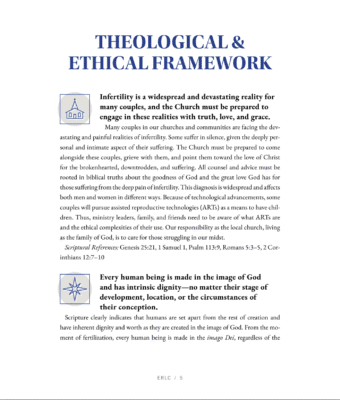
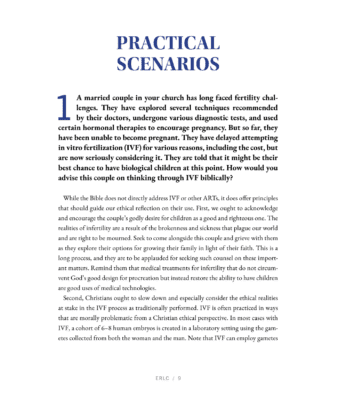
As we engage issues of bioethics centered on the sanctity of life, the complexities of this subject require theologically and biblically grounded ethical responses coupled with compassionate pastoral care. The format of this guide provides just that—a theological framework in part one and practical scenarios in part two. The scenarios in this guide are reactive, created intentionally so we can proactively consider potential issues in our own congregations and equip our churches to address the ethical implications of ARTs. The goal is to help local churches, pastors, ministry leaders, and other Christians navigate the heart-wrenching difficulties of infertility in light of the technologies available to couples who desire to have children. We pray that the guide will help our churches think through the ethics of ARTs, shepherd and care for families affected by infertility, and respond lovingly with the hope of the gospel.