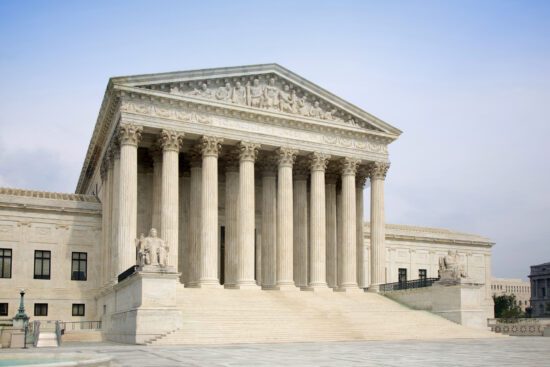


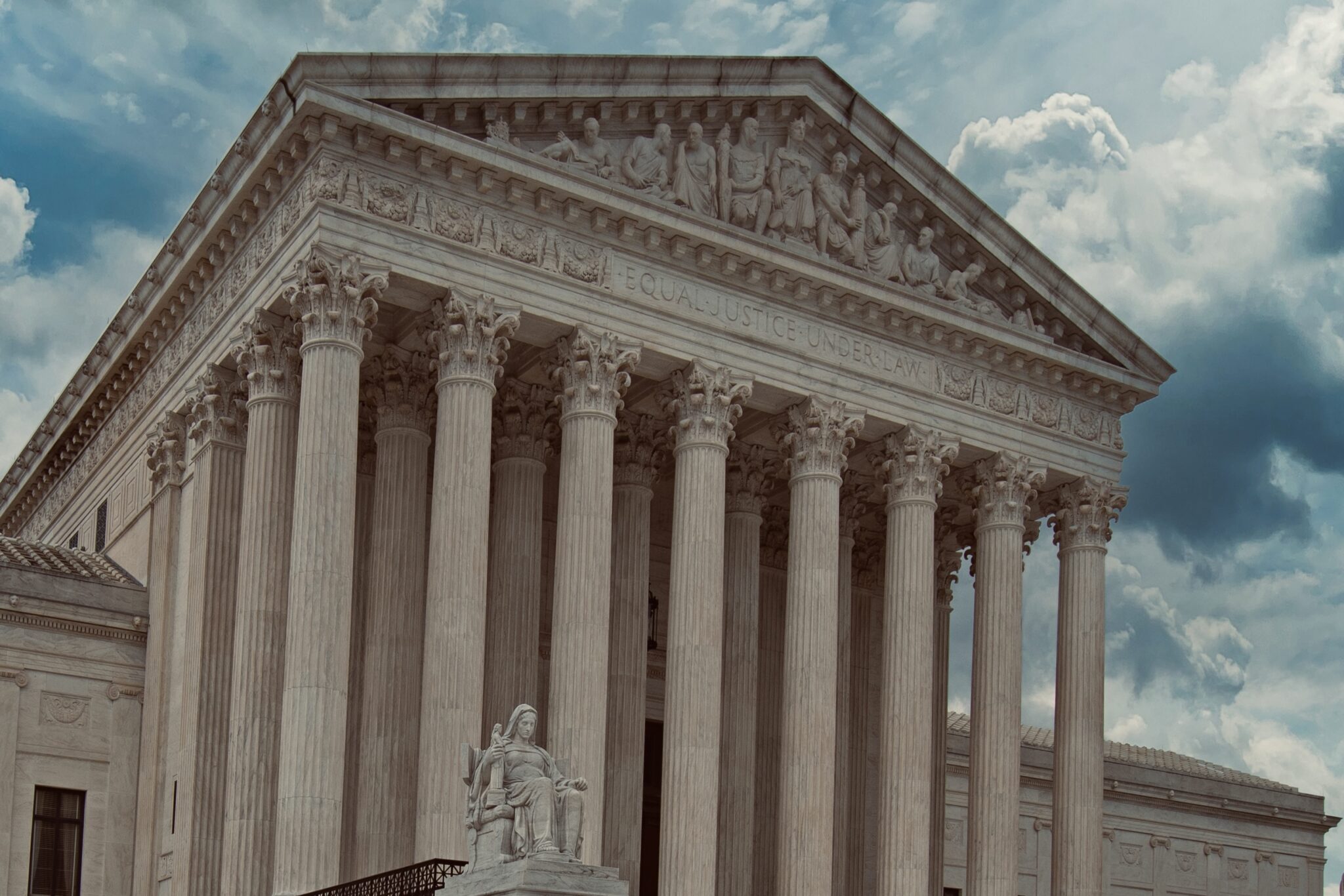

Today, the U.S. Supreme Court released its decision in the case United States v. Rahimi, upholding protections for vulnerable individuals experiencing domestic violence. Rahimi challenged whether or not individuals subject to a domestic violence restraining order may be temporarily prohibited from possessing a firearm if they are found to be a credible physical threat to their family member.
In an 8-1 decision authored by Chief Justice John Roberts, the court held that such a law is constitutional and that “an individual found by a court to pose a credible threat to the physical safety of another may be temporarily disarmed consistent with the Second Amendment” (17). Justices Neil Gorsuch, Brett Kavanaugh, Amy Coney Barrett, Ketanji Brown Jackson, and Sonia Sotomayor joined by Elena Kagan, all authored concurring opinions, and Justice Clarence Thomas was the dissenting voice.
What is this case about?
As Chief Justice Roberts makes clear in this opinion, there is no doubt that Zackey Rahimi has an extensive history of physical violence, harm, and egregious illegal activity.
- Rahimi threatened the mother of his child with a firearm, fired as she fled, then threatened her with the firearm once more if she attempted to report this threat, resulting in a domestic restraining order.
- Additionally, Rahimi later violated the terms of his existing restraining order, repeatedly harassed his domestic violence victim through social media, and threatened an additional woman with a firearm.
- Furthermore, between December 2020 and January 2021, Rahimi was involved in five shootings at and around Arlington, Texas, which related to his selling of illegal drugs, multiple road rage incidents, and a declined credit card at a restaurant.
In response, law enforcement searched his home and found multiple firearms, which were confiscated in accordance with existing federal law that prohibited an individual with a qualifying domestic violence restraining order from obtaining or possessing a firearm. Rahimi was indicted for violating this federal law, then challenged the law that made his conduct criminal by arguing that the Second Amendment, as interpreted by New York State Rifle & Pistol Assn., Inc. v. Bruen (2022), made the underlying federal law unconstitutional.
What were the core arguments?
The plaintiff, Rahimi, argued that a new test developed by Thomas in the Bruen case rendered the federal law prohibiting him from possessing a firearm unconstitutional. Rahimi did not argue the legitimacy of his restraining order, nor the claims of his abuse of his own child and his child’s mother. The court found no reason to doubt that Rahimi presents a “credible threat” to their physical safety (2). Instead, Rahimi chose to challenge the constitutionality of the underlying law that prohibits him from possessing a firearm in light of the Bruen decision.
The Bruen decision established a new legal test for evaluating challenges to the Second Amendment. Under the framework, the constitutionality of any restrictions on firearms must include an examination of text, tradition, and history surrounding the Second Amendment. In the majority opinion, Roberts stated that a court must determine if a law should remain in place by “apply[ing] faithfully the balance struck by the founding generation to modern circumstances.” (2) Roberts explains that “if a challenged regulation fits within that tradition, it is lawful under the Second Amendment,” according to Bruen.
The federal government argued that the law restricting access to firearms for domestic violence perpetrators was consistent with the test laid out in the Bruen decision. This case was the first opportunity for the Supreme Court to clarify the application of this standard established in Thomas’ 2022 opinion.
What did the Supreme Court decide?
The Supreme Court ruled that the law in question “fits comfortably” within the historical tradition of firearm regulation in the U.S. and thus, passes the test set forth in Bruen. (5). As a result, this law remains in effect, ensuring that domestic violence perpetrators who pose a credible threat to the physical safety of others and have been issued a restraining order cannot possess a firearm.
The majority opinion argued that “Since the founding, our Nation’s firearm laws have included provisions preventing individuals who threaten physical harm to others from misusing firearms” (5). The court also stated that modern laws need not be identical to those present at the time of the founding but rather must be “consistent with the principles that underpin our regulatory tradition” (7).
The court affirmed that two types of laws present at the time of the founding support regulations consistent with the law in question.
- Surety laws, both “could be invoked to prevent all forms of violence, including spousal abuse” and “also targeted the misuse of firearms” (11). Similar to the law in question, these laws “often offered the accused significant procedural protections” (12) and were limited in duration (13).
- The court also found that “going armed” laws, which prohibited certain actions with dangerous weapons which could “terrify the good people of the land” and “disrupt the public order,” were relevant to this case (13).
The court believed that “Taken together, the surety and going armed laws confirm what common sense suggests: when an individual poses a clear threat of physical violence to another, the threatening individual may be disarmed” (13).
While the concurring opinions disagree on what the further application of the Bruen test should be, consistently each of the eight justices making up the majority opinion found that this law does not violate the right to bear arms laid out in the Second Amendment and concluded that this law clearly withstands the Bruen test.
Why does this matter for Southern Baptists?
As Southern Baptists, we believe that life, regardless of age or ability, is inherently valuable and worthy of protection. Just as we advocate for the protection of vulnerable preborn lives, we care deeply for the vulnerable women and children suffering domestic violence.
While no law and no government will be fully perfect, the purpose of each law and of our government is to restrain evil and promote the good. As stated in the Baptist Faith and Message 2000, “We should work to provide for the orphaned, the needy, the abused, the aged, the helpless, and the sick. We should speak on behalf of the unborn and contend for the sanctity of all human life from conception to natural death.”
When uniquely dangerous individuals threaten others, it is good to protect life and oppose violence and evil. Today’s decision rightly protects our constitutional rights while upholding the responsibility of government to safeguard the lives of vulnerable citizens, especially when their lives are at risk by those making credible threats.