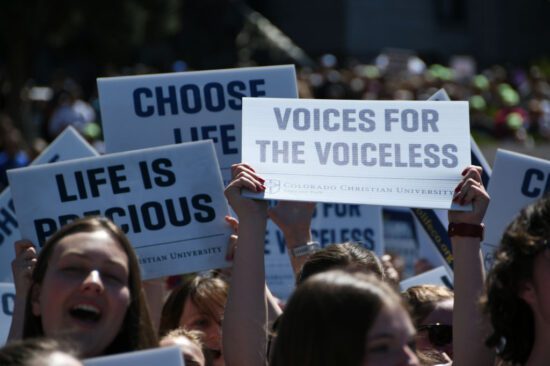





I remember very clearly the first pro-life event I attended at age 15. A friend’s family invited me to go with them to a march and rally in our state capital of Montgomery, Alabama. The passion on display that winter day moved me as I walked among the mass of people carrying signs and crying out for the preborn. Until then, I had been principally pro-life but didn’t feel any personal responsibility around the issue. But somewhere amid that crowd, in air so brisk I could see my breath in front of me, I realized God was prompting me to defend the preborn.
The message from speakers that day was simple: Save the babies. Overturn Roe v. Wade.
As pro-lifers, we were united in both our cause and our game plan.
Now we live in a post-Roe world where many states restrict or ban abortion in ways that save countless innocent lives. But alongside this victory, a disagreement brews on the edges of the pro-life movement about how to apply criminal justice to the fight for life. Pro-life advocates have always sought to leverage the criminal justice system to protect the preborn by prosecuting physicians who perform illegal abortions. But a new wave of activists insists that we must also criminally charge women who seek abortions.
This sector of the pro-life world describes their movement as one to provide equal protection under the law to the preborn. Sounds great, doesn’t it? But many who spend their lives working at various levels of the U.S. criminal justice system caution that while the law provides justice in many cases, it has its limitations. The more complex the facts around a crime, the greater the chance of unintentionally compounding or creating one injustice while addressing another.
Demographic realities
To understand the problems connected to this proposition, we must recognize the realities of who will likely be seeking illegal abortions in a post-Roe United States. Now that abortion is banned or heavily restricted in some states and fully legal in others, women with even moderate resources will not risk prosecution to have an abortion. In states where abortion is illegal, most women will leave and travel to states where it’s not, have the procedure with zero risk of prosecution, and return home.
In fact, abortion activists—including the Biden administration—are so dedicated to keeping abortion common that they are placing abortion providers on state borders for easier access and funding organizations to help women travel to abortion-friendly states.
Given the abortion lobby’s zeal for creating access to abortion, what kind of woman will still consider an illegal procedure in a pro-life state? A very poor one, generally, with no resources for travel, no understanding of how to access the free abortion travel funding, and who feels desperate enough to accept the risk of an illegal abortion that may be dangerous and might also send her to jail.
In my years serving abortion-vulnerable women, I observed that as a woman’s level of agency decreases, the likelihood that others are heavily influencing the decision regarding her pregnancy increases. The less power she has—because she’s young, poor, or her partner or parent is coercive—the more likely it is that someone else in her life is calling the shots and insisting that she terminate her pregnancy. And if we make a Venn diagram of low-resource women who will attempt to get an abortion in a state where it’s illegal and low-agency women who aren’t the primary decision-makers, we get a lot of overlap.
Within that overlap is a field ripe for unintended injustice.
Unintended injustice
Those who want to criminalize women insist that we can write statutes that consider those mitigating factors. They say that just as current homicide statutes allow for degrees of crime and charge accessories to the act, criminal abortion statutes could, too. But we also know that the criminal justice system works very differently for those who can afford an adequate legal defense than for those who must depend on an overworked, underpaid public defender.
Which representation do we believe the woman who couldn’t afford a road trip to the state line will receive? How difficult will it be for her to prove, with meager legal resources, that she was coerced or pressured by others to abort when so much of that evidence is “he-said, she-said” in nature?
I think the equal justice crowd—whose burden for the preborn I appreciate and admire in many ways—imagines passing laws that convict and lock up the 30-year-old professional on social media “shouting her abortion.” And to be clear, that woman’s wanton disregard for the preborn infuriates me, as well. But these laws will rarely touch her, if ever. She will continue to live in or travel to an abortion-friendly state. She will keep aborting at will. She will keep shouting about it.
These laws will almost exclusively catch the poor and disenfranchised in their net and few others. Is that justice? Is that equal?
A pragmatic argument
Finally, I hesitate to make a pragmatic argument on a moral issue. Still, when lives hang in the balance, I think wisdom demands that we consider all the potential consequences of the idea on the table. By jailing women in red states (the only states where legislatures might pass such laws), those purple states where voters are pretty evenly divided on the abortion question will be watching. Passing these “equal justice” laws may jail a few women in Alabama or Tennessee. However, the optics of it all will raise millions for the abortion lobby to spend in purple states where abortion policy is still very much a jump ball. We will lose crucial legislative battles in those states to ban or restrict abortion more fully.
And when we lose those battles in purple states, more children will die.
I think the wiser course is to keep our focus on making abortion illegal in every state and focusing resources on women in need who may run toward abortion out of fear. Both of these goals are better accomplished if we can convince the millions of Americans in the middle of this debate that both lives have value—mother and child—and that we, as pro-life Christians, are dedicated to seeing each of them thrive as God intended. By doing these things, we can continue to advance a culture of life.