


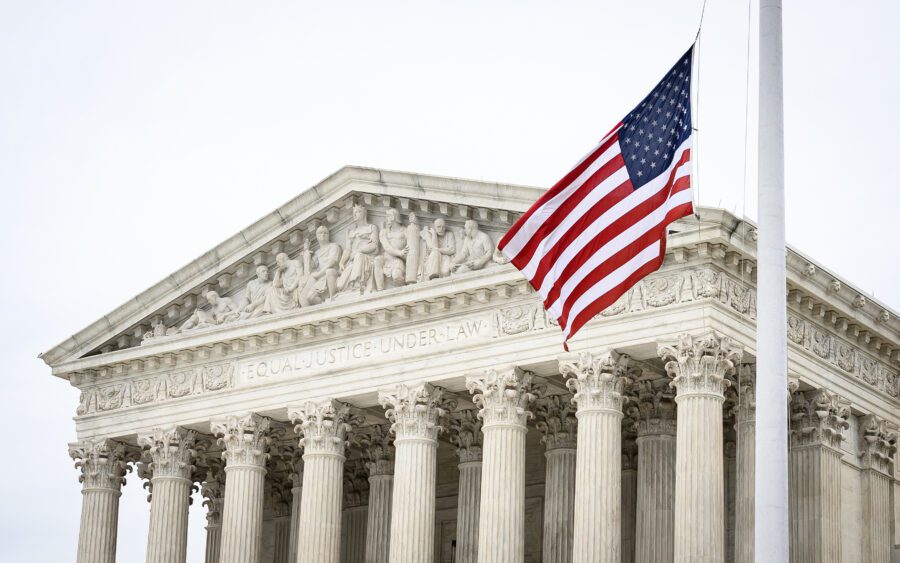

In a unanimous decision today, the U.S. Supreme Court’s decision granted a significant victory in support of religious liberty in Catholic Charities Bureau v. Wisconsin Labor & Industry Review Commission. The Supreme Court rejected the Wisconsin Supreme Court’s erroneous ruling, which created a judicial test used to discriminate against Catholic Charities Bureau for not being religious enough to receive a religious tax exemption. The Supreme Court affirmed that the government should not entangle itself in second-guessing the religiosity of a faith-based organization’s activities.
The ERLC joined religious liberty advocates, including the Minnesota-Wisconsin Baptist Convention, in filing a legal brief in September 2024 urging the Supreme Court to grant Catholic Charities Bureau’s petition to hear the case. When the Supreme Court agreed to argue this case, the ERLC filed an additional brief outlining why the Supreme Court must overturn the new, unconstitutional test created by the Wisconsin Supreme Court and uphold vital religious liberty protections for churches and faith-based entities.
What is this religious autonomy case about?
Catholic Charities Bureau is a ministry arm of the Diocese of Superior of the Catholic Church charged with serving the poor and the disadvantaged. In 2016, Catholic Charities Bureau requested a religious exemption from the Wisconsin Unemployment Insurance Program tax so it could pay into a Bishop-sponsored unemployment program aligned with their religious beliefs. Despite being under the direct supervision of the Catholic Church, the Wisconsin Labor & Industry Review Board denied this request because they determined that the Catholic Charities Bureau’s activities were not “typical” religious activity.
The Wisconsin Supreme Court ruling violated First Amendment protections, long-standing judicial doctrines, and legal precedent. The Wisconsin court reasoned that because Catholic Charities was separately incorporated, served non-Catholics, and did not engage in proselytization, which is against Catholic social teaching, the activities of Catholic Charities Bureau were not religious enough to qualify for the unemployment tax exemption.
In our brief, the ERLC and partners argued that the Wisconsin Supreme Court’s ruling:
- Violated the First Amendment principle of church autonomy, which prevents the government from determining “the validity, meaning, or importance of an organization’s beliefs and practices,”
- Infringed upon churches and religious organizations’ right to freely organize their work according to whatever structure they deem best,
- And established government-approved ways for churches to exercise their faith.
What did the court’s decision say?
In the unanimous decision, Justice Sotomayor wrote
The First Amendment mandates government neutrality between religions and subjects any state-sponsored denominational preference to strict scrutiny. The Wisconsin Supreme Court’s application of [the state’s unemployment tax exemption] imposed a denominational preference by differentiating between religions based on theological lines. Because the law’s application does not survive strict scrutiny, it cannot stand 1(1) https://www.supremecourt.gov/opinions/24pdf/24-154_2b82.pdf.
Strict scrutiny, the highest level of constitutional review, requires any government infringement of the First Amendment to serve:
- a compelling government interest and
- to be the most narrowly tailored means to achieve that interest.
Justice Sotomayor reasoned that Wisconsin’s denial of the unemployment-insurance exemption to Catholic Charities Bureau fails to satisfy strict scrutiny because “the State fails to explain how the theological lines drawn by [the state’s unemployment tax exemption] are narrowly tailored to advance” their compelling government interest of providing unemployment coverage to citizens 2(13) https://www.supremecourt.gov/opinions/24pdf/24-154_2b82.pdf#page=16.
The Supreme Court has previously held that any law “establishing denominational preference” is to be treated as suspect and strict scrutiny review must be applied in order to determine the law’s constitutionality. The court has previously said that the “‘fullest realization of true religious liberty requires that government’” refrain from “‘favoritism among sects.’” (School Dist. of Abington Township v. Schempp) 3(8)https://www.supremecourt.gov/opinions/24pdf/24-154_2b82.pdf#page=11.
The court determined that under Wisconsin’s application of their state law, Catholic Charities ministries would be exempt under the statute if they engaged in “proselytization or limited their services to fellow Catholics.” Under this application, the state is clearly showing a preference for a certain type of religious charity work, and thus the court held that the law was unconstitutional. Justice Sotomayor wrote that a “law that differentiates between religions along theological lines is textbook denominational discrimination,” and that this case “involves that paradigmatic form of denominational discrimination” 4(9)https://www.supremecourt.gov/opinions/24pdf/24-154_2b82.pdf@#page=12.
Justice Sotomayor clarified that:
Decisions about whether to “express and inculcate religious doctrine” through worship, proselytization, or religious education when performing charitable work are, again, fundamentally theological choices driven by the content of different religious doctrines. Id., at 81. A statute that excludes religious organizations from an accommodation on such grounds facially favors some denominations over others 5(12-13)https://www.supremecourt.gov/opinions/24pdf/24-154_2b82.pdf#page=15.
The First Amendment guarantees to religious institutions broad autonomy to conduct their internal affairs and govern themselves.
Justice Thomas
In a concurring opinion, Justice Thomas highlights the importance of the “church autonomy doctrine,” a doctrine that ERLC has continued to defend in countless amicus briefs. Justice Thomas writes:
The First Amendment guarantees to religious institutions broad autonomy to conduct their internal affairs and govern themselves. This guarantee, which we have called the “church autonomy doctrine,” provides that a religious institution is not defined by the corporate entities it chooses to form” 6(Thomas, 2).
Why is this case important for religious autonomy?
Southern Baptists are committed champions of religious liberty and ensuring believers can freely organize and express their faith without government interference. As outlined in the Baptist Faith and Message 2000, “a free church in a free state is the Christian ideal.” Furthermore, in the 2024 Resolution On Defending Religious Liberty, Southern Baptists expressed they would like to “limit government infringement of religious expression.” Through churches, associations, and entities, Southern Baptists organize a wide range of faith-based organizations that are all aimed at fulfilling the spread of the gospel.
When the state tries to define what constitutes religious ministry and activity, it is not only working well beyond its boundaries, it is trampling all over the First Amendment.
ERLC President Brent Leatherwood
Brent Leatherwood, president of the ERLC, commented on the court’s decision:
When the state tries to define what constitutes religious ministry and activity, it is not only working well beyond its boundaries, it is trampling all over the First Amendment. This is the main takeaway from today’s Supreme Court unanimous decision; one that should hearten Southern Baptists and anyone who cares about our fundamental freedoms. This case involved an egregious attempt in Wisconsin to dictate how religious organizations should be structured or what the outworkings of their faith should look like.
Southern Baptists will rightly understand this ruling affirms what we know to be true: that we need to be able to freely share the gospel and live out the tenets of our faith—like offering a hot meal to someone in need, a stable home for vulnerable children, or a helping hand to those in disaster zones—without fear of being bullied into adopting the government’s erroneous view of what that should look like.
The court’s unanimous ruling is significant because it pushes back against the concerning idea that the government can define what qualifies as “real” religious activity.
Today’s decision reinforces and protects our First Amendment protections that are offered to religious organizations to conduct their work and ministry assignments free from government infringement. Importantly, the court clarified that the state may not question a religious organization’s understanding of its own mission when determining eligibility for legal exemptions. This robust precedent will safeguard church ministries from future attempts by government agencies to intrude upon or evaluate the sincerity of religious work.