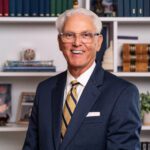
Dr. Hollingsworth joined the ERLC as the entity’s interim president on October 1, 2025 and concluded his tenure on May 31, 2026. On today’s episode, you’ll hear from Dr. Hollingsworth as he reflects on his time leading the ERLC and the firsthand impact he has seen the ERLC’s work have on assisting churches in how to address cultural issues from a biblical perspective.
He also shares what he learned from working alongside pastors, state convention leaders, and policymakers to advocate for the priorities and convictions Southern Baptists care deeply about regarding issues in the public square.
Episode Transcript: Dr. Hollingsworth on what he learned leading the ERLC
Narration:
Welcome to The ERLC Podcast, where our goal is to help you think biblically about today’s cultural issues. I’m Lindsay Nicolet, and today we’re talking to Dr. Gary Hollingsworth, outgoing interim president of the ERLC.
Dr. Hollingsworth joined the ERLC as the entity’s interim president on October 1, 2025 and concluded his tenure on May 31, 2026. On today’s episode, you’ll hear from Dr. Hollingsworth as he reflects on his time leading the ERLC and the firsthand impact he has seen the ERLC’s work have on assisting churches in how to address cultural issues from a biblical perspective.
He also shares what he learned from working alongside pastors, state convention leaders, and policymakers to advocate for the priorities and convictions Southern Baptists care deeply about regarding issues in the public square.
Dr. Hollingsworth has served in ministry for over 50 years, having held pastoral and various leadership roles across the convention. Prior to coming to the ERLC, he served as the executive director of the South Carolina Baptist Convention from 2016-2023. He has also served as a pastor in Kentucky, Virginia, Alabama, and Arkansas. He’s married to his wife, Gwen, and they have two adult sons.
Now, let’s turn to my conversation with Dr. Hollingsworth.
Lindsay Nicolet:
Dr. Hollingsworth, we were so delighted when we first met you last year, and you have just become a forever part of the ERLC family, and we have loved having you lead us in this interim season. We hate to see you go. We’re not really going to let you go. You have to pop your head in here and there, but we just want to talk about your time at the ERLC. So, as you reflect on the time that you’ve spent with us, what have been some of the most meaningful or memorable experiences for you?
Dr. Gary Hollingsworth:
Well, Lindsay, thank you for those kind words to start. And I know I would truly, truly say that the most memorable is just getting to know and work with our team, yourself included. And so many others. We did not know each other. I don’t think any of us really had any kind of personal connection or contact. And so the number one most memorable thing I’ll take away are just the new friends and new ministry colleagues that I’ve met. So let me say that right off the bat. I think the second thing that would be most memorable is it has allowed me to really travel the country and to connect, in some cases, sort of reconnect with good friends and ministry friends that I’ve had over the years and just to connect with them. But the second most memorable thing would be really meeting so many new people all around our conventions, particularly in our state conventions. Last fall, that was sort of the first assignment out of the chute was to have personal time with as many state conventions as possible.
And what I discovered in those meetings, and it was a whirlwind, if you remember, for about six weeks, we were all sort of going here and there, and I couldn’t get to all of them, but you and others of our team made so many of those conventions. But the second most memorable thing is really just hearing what I would call from grassroots Southern Baptists, just about the work of the ERLC. What I discovered is that there were many who had already a profound appreciation and a lot of gratitude for the work of the ERLC over many, many years, and it was always good to connect with those folks. There were then some who, quite frankly, were, I would say, in a state of uncertainty because of some past challenges, but they were very fair for the most part. I’m telling you, once we had a conversation and I was able to just share with them the work that we are now doing and hoped to do in the future, I think it brought a calming effect to some of those.
And then there was a kind of a third category, and I was maybe a little surprised at this, but I do understand the challenge of communicating to so many Southern Baptists across so many different spectrums. But there was a third category that just didn’t have a clue. They just didn’t really. I mean, they may have heard of the ERLC, some of them said, “Now what does that stand for?” And when I laid all that out and they were like, “Oh, I had no idea.” So I would say that the second most memorable thing for me is just being, again, able to engage with Southern Baptists at a grassroots level because we’re not a perfect denomination any more than there are any perfect churches. There just are none, or perfect people for that matter, myself included.
But I think as a whole, the work of Southern Baptists, what brings us together around a common mission, which is the Great Commission, and the values that we share, biblical authority, the inerrancy of the Scripture, deep passion for getting the gospel to the lost, who we really are at our core, imperfect that we may sometimes be in even that effort, I think just a fresh appreciation for who we really are at the grassroots level.
And then one final thing, a third thing, obviously, is it thrust me into some very new and interesting venues for me, particularly in some of the trips I made to Washington, D.C., and connecting with policymakers, legislators, and certainly our team who work up there. And so I would say as far as memorable, just walking into that environment, it can be a little intimidating. But I will admit that our D.C. team, Katy and Tim particularly, they were so well prepared and prepared me so well, so that anytime I walked into a legislator’s office or a venue, sometimes it wasn’t in their office, it might have been a larger gathering and meeting of coalition partners or whatever.
But not one time did I feel unprepared. But I will long carry those memories of having just a brief opportunity to step in really on behalf of Southern Baptists, not bringing my thoughts or my ideas or my opinions, but really trying to speak where Southern Baptists have already spoken and to speak about the things that matter to the vast majority of Southern Baptists. So I’d say those are the three things. Our team, the grassroots Southern Baptists, and really the connection that I had with policymakers.
Lindsay Nicolet:
So as we’ve gotten to know you, we’ve realized that anytime you’re in a room, you probably know somebody there. You’ve spent a lot of time in the Southern Baptist Convention as a pastor in various states as a state convention executive director. There aren’t many corners of the SBC that you have not been in. And yet, I would think that when you stepped into this role at the ERLC, there were aspects of the ERLC’s work that you maybe were unfamiliar with or there were perceptions of the ERLC that you had. So I would love to know, with your pastoral hat on and your executive director hat on, what did you not know about the ERLC that you now know? How has your perspective grown or changed through the interim president role?
Dr. Gary Hollingsworth:
Yeah, what a great question. And first of all, there was a whole lot I did not know, of course I knew at a very high level, and we call it a 30,000-foot view, generally what the work of the ERLC was. But in terms of behind the scenes and sort of the core of the work, every day was a learning day and has continued to be throughout these nine months, still so much more to learn. But I think from an appreciation perspective, honestly, is that I was maybe a little surprised, probably had some expectation, but a little surprised. For example, I want to speak now on the policy side of the equation, which is a part, but it’s certainly not the largest part of the work of the ERLC, but I would say this, that when I stepped into a room or had a conversation, it wasn’t Gary Hollingsworth, nobody really cared about Gary Hollingsworth.
And that was perfectly fine, but I would say the weight, if you will, because when I said I’m here as the interim president of the ERLC on behalf of millions of Southern Baptists, and particularly if I was with a legislator of whatever state they were from, our team had always prepared me so that I could say, “Oh, and by the way, you know, this population of your state’s five million people, and of those five million, 600,000 of them go to a Southern Baptist church is in your state.” Let me tell you what, they understand that. And so what I’m trying to say is the weight of the influence, the potential influence that is there, not because of one individual, no matter who the president might be, of course, excited about Dr. Lenow, and he’s going to do such a great job, but when he walks in that room, yes, he’s an individual.
Or when our team goes in the room, we’re several individuals. But really speaking on behalf, not our opinions, but speaking about things that are so very important, we know there are many things that we do know Southern Baptists and the lions share agree on. And so I would just simply say that one of the things I was pleasantly surprised at was sort of the weight of the influence of that and what that carries. I’d say the second thing I really had, again, no earthly idea of the wealth of resources that are already done and there at the disposal of every Southern Baptist. And so I would say to every pastor, to every church leader, to every lay person who is interested, and again, I’ll give just a small example. Our church guides, for example, you know, I usually carried a satchel full of those with me wherever I went.
I still carry those with me. And when I get to give them to a pastor and lay out, you know, here are the guides that we’ve already done in the past, here’s what we’re working on, here’s our newest one, for example, is that, I just watch pastors leaf through that and begin to say, “Wow, I wish I’d had this six months ago or six years ago.” So the wealth of resources and the wealth of help that is already available for every Southern Baptist and particularly for Southern Baptist pastors and leaders, I admit, I kind of knew it was out there, but I’d never taken time to know how much was out there. And behind that, I would also say the incredible amount of work that was done in order to make those things happen, whether it’s the guides or even on our website, for example, if a person is even interested in knowing this is sort of a, I call it Supreme Court season right now.
Some fairly significant decisions will be coming down in the month of June as always is the case. And I could tell pastors and people who might have questions, have you looked at the website? And you know, I can’t tell you how many times I’ve sat with my phone or my iPad or a computer and said, “Well, hey, give me five minutes, and let’s just look.” And you go on, and you find all of the information about cases that are currently pending, oral arguments that have already taken place or about to take place. Many times decisions that have already been made, and again, with an explainer about why does this matter to Southern Baptists. So I think that’s an exciting part for me that honestly over 50 years of Southern Baptist work and ministry, and I can wrap all that up to simply say that in my 50 years plus, I had an appreciation for the work that the ERLC does. I have an incredibly deeper appreciation for what the ERLC does and the value that our resources bring to our people.
Lindsay Nicolet:
I love to hear you say that. And it’s funny, just the other day I had a question. My daughter goes to the little public school in our neighborhood, and I had a question about just some various aspects of that. And I was able to look up on our website and remember that we had this very practical article and it just reminded me how we’re able to serve pastors and churches and ministry leaders, Southern Baptists, with the resources that we produce. So it made me happy to see and how it applied to me, I was able to use that resource.
So as a former state director, you kind of talked about the pastoral, the way you just shared with your pastoral hat on and the resources for the church as a former state director. Of course those resources apply and the availability for churches in the state directors’ state. But what would you want your brothers in arms to know about the ERLC and how the ERLC comes alongside churches and state conventions?
Dr. Gary Hollingsworth:
Oh, great. That’s kind of an easy question. And they are brothers in arms. Many of them have been longtime friends, many of them are kind of new friends because there’s been quite a bit of turnover in say, executive director positions. I believe there were 12 new ones introduced at our retreat that I attended earlier this year. So what I would really say to my brothers would simply be this, don’t be afraid of the ERLC. Don’t worry if you’ve had angst in the past about whether you can trust this or that, or you agree or don’t agree with certain things. I would say to them, again, it doesn’t take a lot of time. It didn’t take me a lot of time, but, again, get on that website and do a little research for this reason is that state executive directors, having served as one there in South Carolina, is that the connection and contact that we have with our churches.
And I would say the very same thing to associational missional strategists, our AMS at the associational level as well, is that I think all of our state leaders and our associational leaders can really sort of serve as ambassadors, if you will, because they are closer to the churches. They ought to be closer to the churches. And we have such a small team, as you well know, a very limited amount of human resources. But every time that gets multiplied, both at the state level, the associational level, the local level, I would simply say to my brothers, take a few minutes to just learn a little bit more about what’s available, what research is out there, and don’t be afraid to use it and share it. And I’m going to say the other thing is also knowing now the heart in these early moments, before Dr. Lenow takes the reins and the helm, is that I know he’s going to be someone who will listen first. And I think that’s so important. And one of the ways that I think going forward the ERLC can even provide more value added to our churches is to really know, again, what’s the heartbeat? What’s going on out there? We know a lot of things, but we can’t know everything. And we may know what’s happening at the federal level where we typically kind of work more directly in policy matters, but to just know what’s going on in their state, what are the issues that are hot button issues in your state, in your local communities. So I would say to my state executive colleagues is, again, you will build a fast and long lasting relationship. I know with Dr. Lenow, as you have with me, not even in this role, but just I would simply say to them, don’t be afraid to pick up the phone and ask or call or talk or if there’s a concern, share it.
And we use a line a lot, and it’s more than a line. It is a truth. It is a principle when we talk about our cooperative way of doing missions and doing our work. The very heart of the Cooperative Program, all that is is a financial vehicle, the Cooperative Program, but it’s a significant vehicle. Again, here’s the line that we can do more together than we can do by ourselves. And so I would say, again, to my state colleagues, make sure that when you’re making your list of key partners, the ERLC is right there on your speed dial.
Lindsay Nicolet:
That’s a good word, and it is sincere. Truly, the heart of all of our staff members is to listen. And you mentioned listening and how that is the heart and the desire of Dr. Lenow as he takes the helm. What else are you most hopeful for as you look to the future of the ERLC?
Dr. Gary Hollingsworth:
I think I’m hopeful, number one, I think that this is a window of opportunity, not looking back in all the past, my goodness, we can all, in our own lives, our own ministries, we always can look back with things that I wish I would’ve done differently. Or I wish I’d have known that, what I know now then or whatever. I think I’m most excited that this is a moment of opportunity. It’s a fresh moment of opportunity. I’m excited about that. I think the second thing is that I’m excited to see what I pray will be a real rallying, if you will, of the bulk of our Southern Baptist family. It won’t be everyone. I understand that. Because when you’re dealing with political matters, social matters, ethical matters, whatever, you know, those can be very complex. And you’re going to find a wide range of opinion about, and not just politics.
I’m not just talking about the political things, but even things that, you know, we might think are no-brainers on moral issues, for example, whatever that might be. But I am excited because I think that with this fresh opportunity, I do believe it would be exciting for me personally to be able to look and see how Southern Baptists are coming more and more together in a more unified voice as opposed to a lot of the splintering divided voices that seem to be out there in so many corners. I’m excited about that. And I think the final thing, as I think about the future, you know, we really think that all the ERLC does is worry about what goes on in Washington. That part of it. We want to know what’s going on in Washington. But you know, the reality is that Washington changes every four years or every eight years.
And politics is what it is. It’s politics. And because we seek really to be truly nonpartisan in that regard, we just want to stay focused on biblical issues. What does the Bible have to say about, and if we lead with that, what is the theological underpinning of and pick the topic. So I’m excited to know that, again, no matter which way the wind blows, what happens in Washington, who’s in the seat, whether it’s the president or a legislator, Supreme Court, whatever, I think that the ERLC and other very like-minded, strongly conservative evangelicals, as we call them, coalition partners, I believe that they’re a steadying voice out there that needs to be had. It needs to be heard. And so I’m excited, personally, about thinking about the future years under Dr. Lenow’s leadership is that steady voice, not just of the ERLC, but quite frankly, of our entire Southern Baptist family and all of the ministries, our seminaries, our mission boards, Guidestone, and you know how they come alongside.
I’m just as excited or more excited at this stage in my life, in my kind of semi-retirement years, we might call it. I’m as excited about the future. I know a lot of people think that we’re going down and we don’t have a future. We might get a little smaller, but I think that we could even be more focused, leaner and meaner, perhaps meaner in a good way, not a mean way, but just doing more even with fewer resources because the work of the Kingdom is God’s work, and we just get to be a small part of it. So, I’m really excited about the future to see what God’s going to do in the coming generations.
Lindsay Nicolet:
And you mentioned semi-retirement. We know that you do not do retirement. Well, that’s what you’ve said. And so what is next for you in this season and how can we be praying for you?
Dr. Gary Hollingsworth:
Well, thank you. In the very immediate way, I’ve already agreed to step in to help a church, First Baptist Opelika, Alabama. A wonderful congregation that is still reeling from a very tragic thing, the sudden death of their longtime and beloved pastor Jeff Meyers. So I’m going to be mainly filling in with preaching duties and coming alongside their staff and some of their lay leaders in the coming months, perhaps until they find the pastor. So I’m excited about that. As you well know, in my early days of retirement, when I stepped aside nearly four years ago now from the South Carolina Baptist Convention, I’ve also been working as an ambassador for Mission Dignity with Guidestone. And at some point, probably even later this year, I’m going to step back in. I love that work. I believe in that work. We come alongside pastors and many times their widows who are struggling financially, who are living out or below the poverty level, and we get to come alongside and help them in their retirement days.
So I never felt like I was retiring from ministry. I did believe that I was looking for a little margin in my life. And God has been good to give us that margin, even though this has been a busy, busy season. So I would just simply say, Hollingsworth is not done yet. As long as God keeps giving me opportunities, I just want to be obedient, and I want to be faithful, and I just want to be a part in whatever way he wants me to be a part of what he’s doing in this world. And I will say this, my true love, beyond my family—and I love my family, our granddaughters and our sons, want to spend quality time with my family, of course—but I have a deep, deep love for pastors and for churches, the local church. And again, I just want to be available to come alongside if I can and be a source of help, if possible. But I’m looking forward to some fun days, but maybe a few more off days in the coming weeks and months than I’ve had since last October.
Narration:
We are grateful to Dr. Hollingsworth for the way he has diligently led the ERLC during a time of transition and for his heart to love and serve SBC churches and pastors across the country. We are continuing to pray for him and his wife as they serve the Lord faithfully in the coming years. And we look forward to the future of the ERLC under Dr. Evan Lenow.
Thank you for listening to this episode of The ERLC Podcast. Join us next time as we talk about the pregnancy resource center’s Supreme Court victory.