

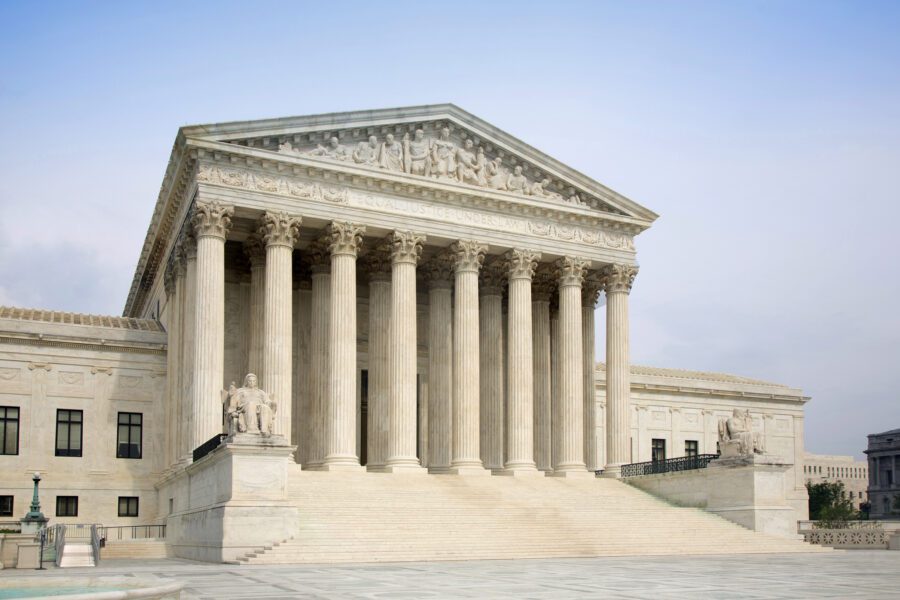

A Rastafarian lost his challenge before the U.S. Supreme Court today (June 23) to seek monetary damages against Louisiana prison guards who forcibly shaved his head, in a case that saw the trio of liberal justices upholding religious liberty.
But in the 6-3 ruling, justices deemed conservative said the plaintiff could not sue the guards who restrained him while shaving dreadlocks he had grown at least 20 years in compliance with a biblical Nazirite vow. Instead, under the Religious Land Use and Institutionalized Persons Act of 2000 (RLUIPA), the officers were not liable for monetary damages, the court ruled, because the officers never agreed to be sued.
The Ethics & Religious Liberty Commission (ERLC), among dozens of religious and legal groups and individuals that filed amici briefs on behalf of the plaintiff, compared RLUIPA to the Religious Freedom Restoration Act (RFRA) in promoting RLUIPA as a clear avenue for the plaintiff to seek redress.
ERLC President Evan Lenow said the ruling “leaves a gap in religious liberty protections” for incarcerated individuals.
“Whether it is burning a Christian’s family Bible, destroying a Jewish person’s yarmulke, or shaving a Rastafarian’s hair, our justice system should ensure there are appropriate methods of relief to right unjust wrongs,” Lenow told Baptist Press. “The ERLC will continue advocating for religious liberty as we pray for true restoration and healing that only comes through faith in Jesus Christ.”
Dr. Evan Lenow, president of the ERLC
He affirmed religious liberty as a long-standing Baptist distinctive, referencing “numerous Southern Baptist resolutions throughout our history which reject government restriction of religious opinion and limit government infringement of religious expression.”
Most recently, messengers to the 2026 Southern Baptist Convention Annual Meeting passed the resolution “On the 250th Anniversary of the United States and the Baptist Contribution to Religious Liberty,” which Lenow said “reminds us of ‘our historic Baptist commitment to religious liberty for all people,’ recognizing it as a God-given right grounded in the dignity of every human being made in the image of God.”
In the case at hand, Landor v. Louisiana Department of Corrections and Public Safety et al, Damon Landor originally sued the Louisiana Department of Corrections (LDOC) and select individual officers for monetary damages. Landor claimed the defendants violated his religious freedom guaranteed under RLUIPA when they shaved his head while knowing it violated his Nazarite vow as a Rastafarian. After lower court hearings, the case against the LDOC was dropped, while Landor continued to pursue the case against the officers. The state officers shaved Landor’s head near the end of a five-month prison stay in 2020 when he was transferred to the Raymond Laborde Correctional Center in Cottonport.
Read the full article from Baptist Press.