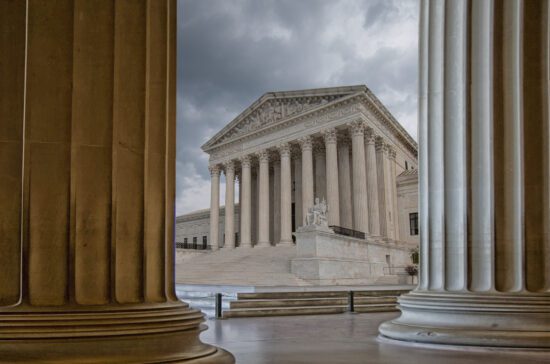



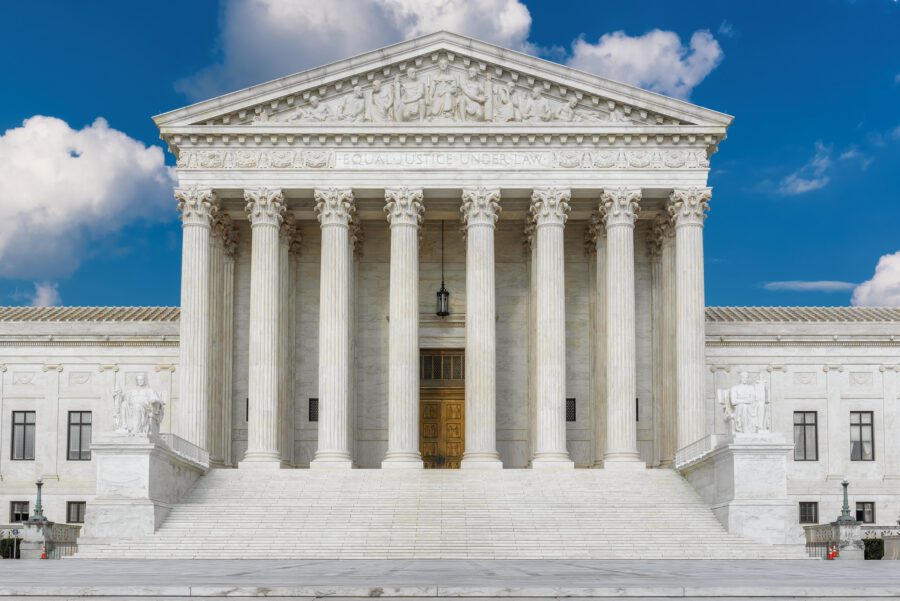

In a monumental combined decision, the Supreme Court ruled that Idaho and West Virginia’s laws prohibiting biological men from competing in women’s sports are permissible under both Title IX and the Equal Protection Clause. This decision helps uphold the laws in 27 states that prevent biological males from competing in women’s sports.
The ERLC joined others in filing an amicus brief supporting the Idaho and West Virginia laws, arguing that “sex” means “biological sex” and that men should not be permitted to compete in women’s sports.
What is the Idaho (Little v. Hecox) women’s sports case about?
Background
Idaho passed the Fairness in Women’s Sports Act in 2020 to prevent biological men from competing in women’s sports in all public schools, elementary through college. In response to the law, “Lindsay” Hecox, a biological male, filed a lawsuit against the state after wanting to join the women’s cross country team at Boise State University. The case was later joined by another transgender high school student referred to as Jane Doe. Together, they allege that Idaho’s law protecting women’s sports violates their 14th Amendment rights to equal protection.
Lower court rulings
The district court issued an injunction in 2020, finding that the law likely violates the Constitution. The injunction was upheld by the 9th Circuit Court of Appeals but remanded to the lower court to determine the appropriate scope.
The question
Whether laws that seek to protect women’s and girls’ sports by limiting participation to women and girls based on sex violate the Equal Protection Clause of the 14th Amendment.
What is the West Virginia (West Virginia v. B.P.J.) women’s sports case about?
Background
At the center of this case is a 2021 West Virginia law, the Save Women’s Sports Act, requiring public school and collegiate sports teams be designated according to biological sex. A male West Virginia student referred to as B.P.J., who has identified as a girl since third grade, brought a lawsuit against several state agencies, arguing West Virginia’s law violates Title IX of the Education Amendments and the Equal Protection Clause of the 14th Amendment. B.P.J. is on the girls’ cross county and track teams at school and recently won the West Virginia Class AAA high school state championship in girl’s shot put.
Lower court rulings
The district court granted an initial injunction allowing B.P.J. to continue running on the girls’ teams, but the final judgement found the law constitutionally classifies on biological sex to protect the state’s interest of fair opportunity in girls’ sports. The Fourth Circuit Court of Appeals partially reversed judgement saying the law did violate Title IX and factual disputes prevented ruling on the equal protection claims.
The question(s)
- Whether Title IX of the Education Amendments of 1972 prevents a state from consistently designating girls’ and boys’ sports teams based on biological sex determined at birth; and
- Whether the Equal Protection Clause of the 14th Amendment prevents a state from offering separate boys’ and girls’ sports teams based on biological sex determined at birth.
What did the Supreme Court’s decision say about Title IX?
On the question of Title IX, only relevant to West Virginia v. B.P.J., the Court ruled unanimously that Title IX permits states to designate sports teams based on biological sex. In the opinion from Justice Kavanaugh, the Court explained that Title IX provides that “No person … on the basis of sex, be excluded from participation in, be denied the benefits of, or be subjected to discrimination under any education program or activity receiving Federal financial assistance” (Pg. 8). This includes school sports teams.
Justice Kavanaugh explained that Title IX allows for separate sports teams for men and women because of the “inherent physical differences between biological women and biological men” (Pg. 10). In congruence with the ERLC’s amicus brief, the Court’s majority held that requiring women to compete against biological males creates significant safety risks and undermines the fairness Title IX was built upon.
The Court also reasoned that “sex,” as used in Title IX regulations, “cannot plausibly be interpreted to refer to anything other than biological sex,” as biological sex would have been the ordinary meaning of the term when the statute was passed (Pg. 10).
Justice Gorsuch authored a concurrence where he similarly voiced his agreement with the majority but wrote separately to specify the complexities of Title IX. Justice Gorsuch reiterated that Title IX was enacted under the spending clause powers of Congress, requiring a funding recipient to “voluntarily and knowingly” agree to the conditions of funding. In this context, there is nothing within Title IX that indicates to funding recipients that they are prohibited from restricting a school-sponsored sports team to one biological sex.
Justice Jackson concurred with the majority on their decision but with a caveat. She wished to leave room for a broader interpretation of the term “sex” as it relates to Title IX, believing it “makes room for individuals to live in the gender they choose; it cares not just about sex assigned at birth” (Pg. 3).
What did the Supreme Court’s decision say about equal protection?
On the question of equal protection, relevant in both women’ sports cases, the Court split 6-3 in the decision along ideological lines. Justice Kavanaugh succinctly explained what the Court must evaluate pertaining to equal protection challenges. In the context of these two cases, the Court considered,
“What are the States’ interests in maintaining separate teams for males and females, and in limiting female teams to biological females? And is the States’ sex-based classification—that is, the limitation of women’s and girls’ sports teams to biological females—substantially related to those interests?” (Pg. 16).
The Court held that states’ interests in ensuring safety and fairness in women’s sports are legitimate purposes. In limiting women’s sports to women only, the state’s classification is substantially related to its interest in fairness and safety, surviving the equal protection challenge.
Both plaintiffs, B.P.J. and Hecox, argued that the laws violated equal protection because they have successfully mitigated their biological advantages through puberty blockers and hormones. They believed they should be exempted from the sex-based classification since they fall outside the state’s reasoning of fairness and safety. However, as Kavanaugh explained, “In the distinctive sports context… the States may treat all biological males the same and treat all biological females the same, given the inherent physical differences between biological males and biological females” (Pg. 20).
In his concurrence, Justice Thomas specified that he is in complete agreement with the majority’s decisions, but wrote separately to articulate that sex is an immutable biological characteristic which operates on a binary (male or female), and that “… to use language to obscure reality – to show ‘indifference regarding the truth’ – is to lie to the public and cease to treat our fellow citizens ‘as equals’” (Pg. 2).
Justice Sotomayor, Kagan, and Jackson dissented to the majority’s ruling on the 14th Amendment equal protection issue. The dissenting judges argued that the state’s interest will not be furthered by excluding transgender athletes in their preferred sports category. Sotomayor argued that B.P.J. is more similar to biological females, and forcing B.P.J to participate in biological male sports would be an act of discrimination contrary to the principles of the Equal Protection Clause. She wrote that “the Court therefore needs additional facts to assess whether B.P.J. is in fact correct, and whether, as a result, the state has “unnecessarily refused her an exception” (Pg. 18).
Why do these women’s sports cases matter to Southern Baptists?
Not only is this a matter of constitutional interpretation, but of biblical and moral clarity. As the Baptist Faith and Message 2000 lays out, “[God] created them male and female as the crowning work of His creation. The gift of gender is thus part of the goodness of God’s creation.” Southern Baptists have consistently opposed biological men competing in women’s sports and affirmed sports should be designated based upon biological sex. The most recent instance of this affirmation was at the 2025 annual meeting in Dallas with the resolution “On Restoring Moral Clarity through God’s Design for Gender, Marriage, and the Family.” This not only ensures fairness and safety in sports but also protects sex-specific spaces and honors God’s design for gender.