

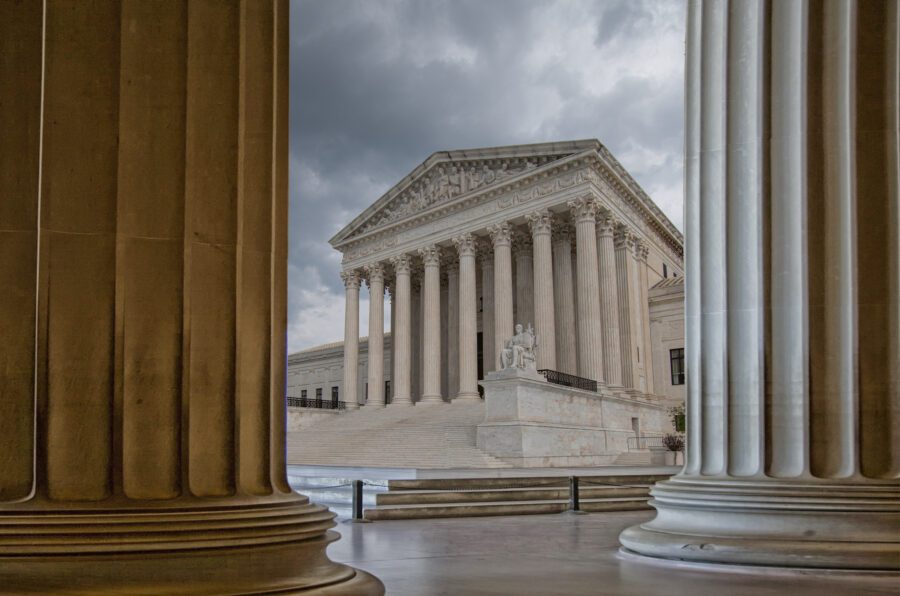

The Supreme Court handed down its decision in Landor v. Louisiana Department of Corrections and Public Safety today, ruling that the Religious Land Use and Institutionalized Persons Act (RLUIPA), a key religious liberty statute, does not allow individuals working on behalf of the government to be personally sued for monetary damages when they violate a prisoner’s religious liberty.
The 6-3 decision, authored by Justice Neil Gorsuch, found that RLUIPA does not permit “individual capacity damages,” or monetary penalties, against personal individuals who participated in the violation of someone’s religious liberty rights.
The ERLC filed a brief in the case encouraging the Court to interpret the identical language of the Religious Freedom Restoration Act (RFRA) and RLUIPA the same way, to ensure religious liberty protections and remedies remain consistent for harmed individuals.
What is this religious liberty case about?
Background
Damon Landor, a practicing Rastafarian, was imprisoned in Louisiana for five months as a part of a drug possession sentence. As a part of his Rastafarian faith, he did not cut his hair for 20 years in order to grow dreadlocks as a part of his religious expression. In accordance with federal appeals courts precedent, his first prison accommodated his hair. However, a few weeks before the end of his sentence, he was transferred to a new prison. While there, a guard and warden threw his court decision in the trash, handcuffed him to a chair, and forcibly shaved his head.
The abuse committed against Landor clearly violates the Religious Land Use and Institutionalized Persons Act (RLUIPA), a sister statute of the Religious Freedom Restoration Act (RFRA). RLUIPA prevents the state from substantially burdening the religious expression of inmates. Upon his release, Landor sued the Louisiana Department of Corrections, the prison, the warden, and other officials for monetary damages, which was challenged in the courts.
Lower court rulings
The district court dismissed the part of Landor’s case seeking individual capacity damages, arguing RLUIPA does permit monetary damages from individual officials. The dismissal was affirmed by the Fifth Circuit, prompting Landor to petition the Supreme Court for review.
The question
Whether an individual may sue a government official in his individual capacity for damages for violations of the RLUIPA.
What did the Court’s decision say in this religious liberty case?
In the majority opinion, Justice Gorsuch, joined by Chief Justice Roberts, and Justices Thomas, Alito, Kavanaugh, and Barrett, expressed that Landor cannot bring a lawsuit seeking damages from the prison officials that forcibly shaved his head in their personal capacity. The majority reasons that, although RFRA and RLUIPA use identical language, RLUIPA is grounded in Congress’s Spending Clause Power, whereas RFRA is not. As such, Justice Gorsuch writes, “Under the Spending Clause and our precedents, voluntary and knowing consent is key” on the part of the people who could be held personally liable for damages (Pg. 9). In the opinion of the majority, this makes RLUIPA distinct from RFRA.
In the opinion, Justice Gorsuch explains,
“Often, Congress attaches conditions to the funds it distributes. And typically, if a recipient ‘violates those conditions,’ Congress may ‘terminate’ its agreement to provide funds. But because the Spending Clause confers no authority to ‘regulate [the recipients] directly,’ Congress cannot just dictate whatever other sanctions it might wish [if a recipient violates] conditions found in its Spending Clause legislation.” (Pg. 6)
The Court acknowledges that while the Louisiana Department of Corrections and Public Safety has accepted the ability to be sued as the recipient of federal prison funds, the prison officials have not. However, such lawsuits against the Louisiana Department of Corrections (LDOC) do not yield monetary damages. When considering a lawsuit against the state, courts can only award forms of remedial and temporary relief under RLUIPA. The corresponding relief is insufficient in some instances, like Landor’s, when the harm cannot be fully repaid or undone.
What did the dissent say in the religious liberty case?
Writing for the dissent, Justice Jackson, joined by Justice Sotomayor and Justice Kagan, laments the majority’s perceived misapplication of the Spending Clause and the relationship between RLUIPA and RFRA. Justice Jackson analyzes other Spending Clause statutes created before RLUIPA in which the Supreme Court upheld individual capacity damages without it being expressly written in the text.
The dissent turns to assessing the Supreme Court’s decision in Tanzin v. Tanvir (U.S. 2020), which held that “appropriate relief” under RFRA permits individual capacity damages. Explaining that RLUIPA uses identical “appropriate relief” language, Justice Jackson concludes that individual capacity damages in the prison context of RLUIPA may not just be “appropriate relief,” but ‘the only form of relief’ available.” (pg. 8 of the dissenting opinion).
Finally, the dissent insists that employees at state prisons are fully aware of the federal legislation and subsequent requirements that impacts their work. Therefore, by accepting employment at a state penitentiary, such employees give voluntary and knowing consent to be held liable under all applicable federal statutes. Jackson writes, “RLUIPA is no secret. Prison officials know when they sign up to work at a state prison that they must obey the law or face the consequences the law prescribes; this is simply ‘a consequence of their decision to accept employment’”(Pg. 24 of the dissent).
Why does this religious liberty case matter to Southern Baptists?
While this case centers on a Rastafarian man and his hair as religious expression, the question at the center of the case holds broad implications for religious liberty for Christians as well. Hypothetically, a similar case could be brought by a Christian inmate who had his family Bible forcibly taken from him and burned.
While RLUIPA and RFRA are sister statutes containing identical language for “appropriate relief,” RLUIPA is grounded in Congress’s spending power, meaning states and state employees must be given clear notice and accept that they will be liable for damages if they violate RLUIPA. RFRA does not require this sort of notice. For the sake of consistent application of our religious liberty protections across all federal law, the ERLC argued that the identical language in the two statutes should be interpreted in the same manner. Any other method risks watering down religious exercise protections under RLUIPA and RFRA—unless Congress acts to amend the RLUIPA statute.
Religious liberty is a long-standing Baptist distinctive. Along with numerous Southern Baptist resolutions throughout our history which reject government restriction of religious opinion and limit government infringement of religious expression, the 2024 SBC resolution asserts “The state has no right to impose penalties for religious opinions of any kind.” Furthermore, the 2026 resolution On the 250th Anniversary of the United States and the Baptist Contribution to Religious Liberty reminds us of “our historic Baptist commitment to religious liberty for all people, recognizing it as a God-given right grounded in the dignity of every human being made in the image of God.”