Southern Baptists have long defended a free church in a free state
Christian citizenship entails Great Commission obedience. Southern Baptists have long believed that a free church in a free state is essential toward furthering each church’s ability to fulfill the Great Commission within its local contexts. While the Church and government are both ordained by God, they have distinct spheres of responsibility and must be respected. At the same time, citizens can and should actively participate in local, state, and national governance in a constitutional republic like the United States. As citizens, Christians can exercise their faith in a way that influences public life, which presents a unique opportunity while introducing unique challenges.
Christian citizenship is a dual citizenship
We are citizens of an earthly kingdom and God’s heavenly, eternal Kingdom. We are called to be faithful citizens of God’s kingdom while wisely stewarding our earthly citizenship. As Christians, we recognize that we seek to fulfill the Great Commandment (Matt. 22:37–40), to love the Lord and our neighbors within a social and political context. The methods we use to seek human flourishing and live out Christian mission (Matt. 28:19–20) heavily depend on the relationship between church and state, both as individuals and local congregations, and whether the actions of church and state promote the common good. This means Christians can and should participate in civic processes as a by-product of their faith in Christ.
When thinking on Christian citizenship, the opportunity for Christians to be involved in political processes presents several questions the Church must consider.
- What is the proper relationship between the Church and the state?
- Why is preserving religious liberty essential for both the Church and the state?
- What is the role of the Church in social action?
- What responsibility does the Church have in promoting civic virtue?
- Can a Christian run for public office?
- Should churches endorse candidates?
- Should Christians be patriotic?
- Should Christians engage in civil disobedience?
While these questions are not exhaustive, they underscore the complexities of being faithful citizens of our nation and, more importantly, being faithful citizens of God’s Kingdom.
Scriptural principles to guide our thinking for public life
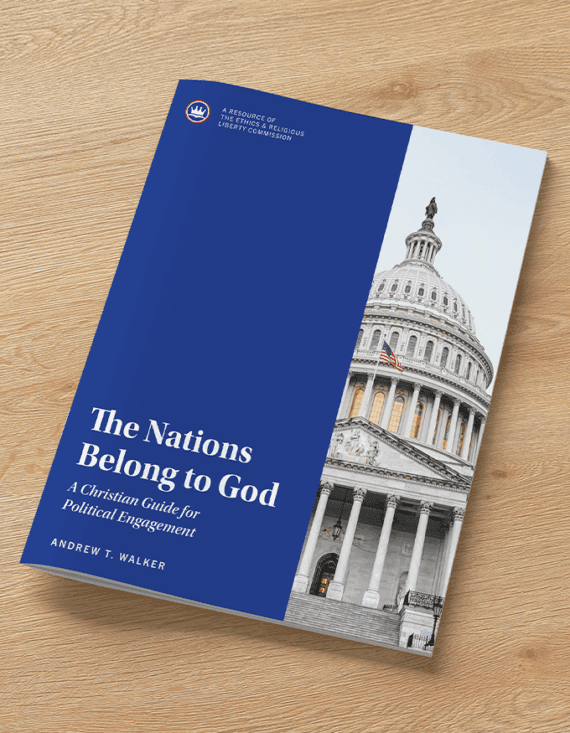
Here at the ERLC, we are committed to serving our churches by providing resources to help Southern Baptists navigate our political structures while remaining faithful to the Lord Jesus Christ and his gospel. It is for this reason that we have produced this church guide on religious liberty and the role of the Christian in public engagement. This guide introduces a theological and ethical framework that combines a biblical foundation for public life with our long-held Baptist convictions stated in the Baptist Faith & Message 2000 and various resolutions affirmed by Southern Baptist churches throughout the years. Additionally, this guide offers various practical, real-world scenarios and questions that pastors, ministry leaders, and churches should consider, along with suggested answers.
We hope this guide serves as a resource for Christians to evaluate our social and political commitments in light of the Church’s mission to spread the gospel of Jesus Christ in every sphere of life.