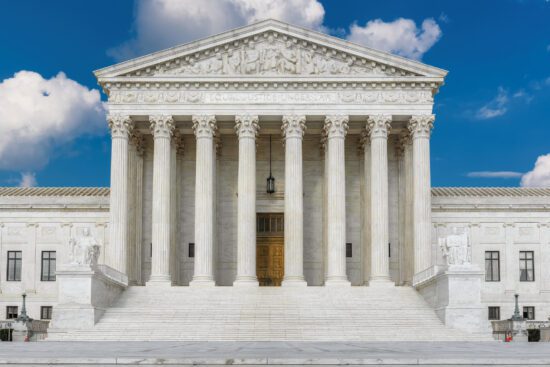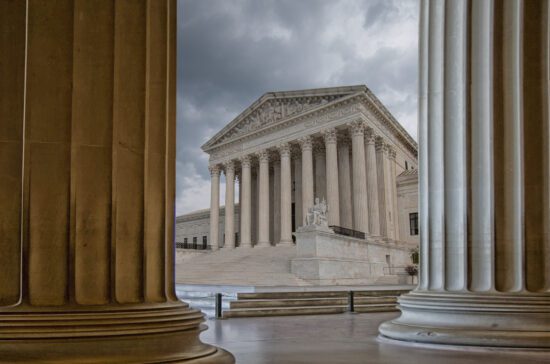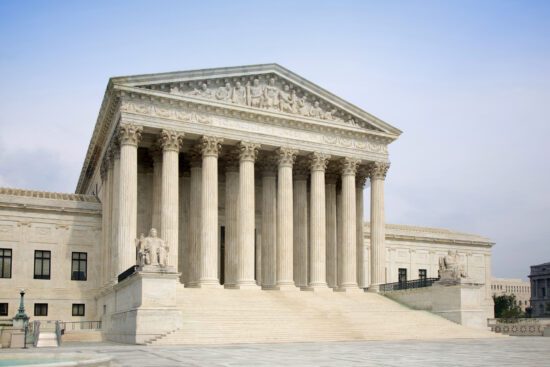


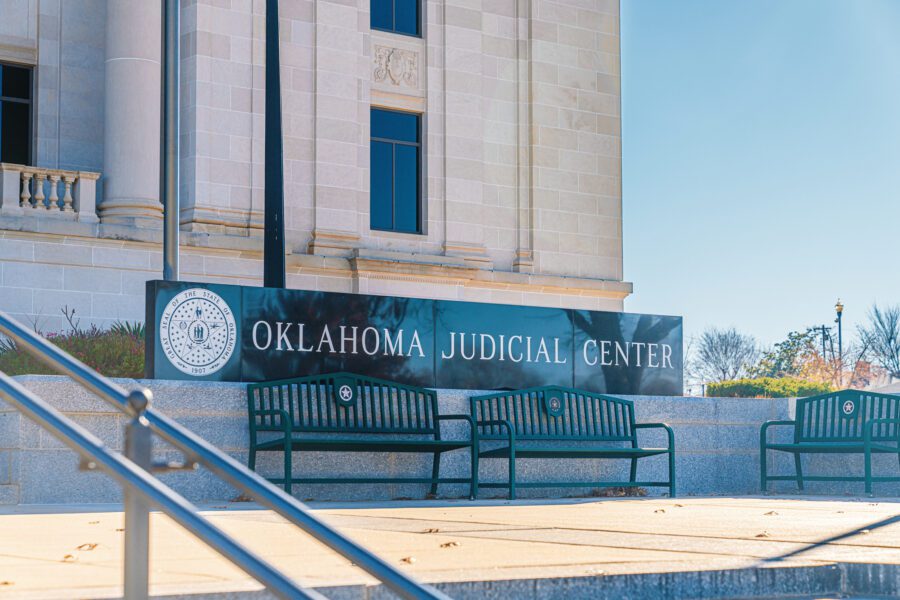

At the end of this month, the United States Supreme Court will hear oral arguments for two related cases that have significant implications for religious liberty. A final ruling from the Supreme Court is anticipated in early summer 2025. The consolidated cases involving religious charter schools are Oklahoma Statewide Charter School Board v. Drummond and St. Isidore of Seville Catholic Virtual School v. Drummond. Both cases address the same two issues, which the SCOTUSblog summarizes as follows:
(1) Whether the academic and pedagogical choices of a privately owned and run school constitute state action simply because it contracts with the state to offer a free educational option for interested students; and (2) whether a state violates the First Amendment’s free exercise clause by excluding privately run religious schools from the state’s charter-school program solely because the schools are religious, or instead a state can justify such an exclusion by invoking anti-establishment interests that go further than the First Amendment’s establishment clause requires.
The purpose of this explainer is to put Southern Baptist views in context, summarize pro and con arguments related to the issues, and discuss the potential implications of the forthcoming court decision.
What is the background for these religious charter school cases?
The Oklahoma Statewide Charter School Board approves charter schools in that state. In 2023, the board entered into a contract with St. Isidore of Seville Catholic Virtual School to operate as a charter school. In response, Oklahoma Attorney General Gentner Drummond sued the charter school board. Drummond contended that St. Isidore could not participate in the state charter school program because of its explicit religious mission. He argued that a Catholic charter school that receives state funding is essentially a religious public school.
Who filed suit?
The charter school board, the school itself, and the sponsoring Catholic diocese contend that, though St. Isidore of Seville was approved to participate in a state program, it will remain a private school. Receiving state funds is not the same thing as becoming a public school, so St. Isidore should not be denied funding on the basis of its religious identity.
In 2024, the Oklahoma Supreme Court agreed with Drummond and blocked St. Isidore from participating in the state’s charter school program. In response, the Oklahoma Statewide Charter School Board and St. Isidore of Seville Catholic Virtual School filed separate suits against Drummond. In January 2025, the Supreme Court agreed to review the cases. In recent months, advocates on both sides of the issue have filed briefs with the high court.
Opposition
Many progressive organizations oppose state funding for religious charter schools. They claim such arrangements violate the separation of church and state and undermine public education. In the Oklahoma cases, organizations such as the Americans United for Separation of Church and State, the American Civil Liberties Union, the Education Law Center, and the Freedom from Religion Foundation have each come out in opposition to St. Isidore’s qualifying for state funding.
Supporters
Many conservative organizations support religious charter schools on the grounds of both religious liberty and educational freedom. In the Oklahoma cases, amici curiae briefs have been filed by groups such as Alliance Defending Freedom, the First Liberty Institute, and the Becket Fund in defense of St. Isidore of Seville and the Oklahoma Statewide Charter School Board. In addition, the United States Solicitor General’s Office and 12 states have also filed friend-of-the-court briefs.
Where do Southern Baptists stand on religious charter schools?
The answer to this question is uncertain.
Southern Baptist views are clear on the wider principles of religious liberty and educational freedom. The SBC is firmly committed to religious liberty, which is reflected in the Baptist Faith & Message 2000 and echoed in dozens of resolutions adopted throughout our history. Since the mid-1990s, Southern Baptists have also expressed support for educational freedom in several resolutions. However, there has been marked development in the concerns Southern Baptists have emphasized over the decades.
1940–1982
During the mid-20th century, Southern Baptists strongly opposed religious schools receiving state funding, appealing to the principle of church-state separation. Much of this historic opposition was in response to efforts by Catholic parochial schools to receive taxpayer dollars. Between 1940 and 1982, at least 15 SBC resolutions addressed this issue directly. Many of those resolutions opposed arrangements similar to the one in Oklahoma, whereby private religious schools would receive state funding while still remaining private institutions. Many of these resolutions also noted strong Southern Baptist support for the public school system while also acknowledging the value of private religious schools.
A common theme in these resolutions is their support for the work of the Baptist Joint Committee on Public Affairs, which Southern Baptists supported financially from 1936 to 1991. Regarding First Amendment advocacy, the Baptist Joint Committee often focused on avoiding any potential violation of the Establishment Clause in public education while also expressing concern for the Free Exercise Clause. This posture of strict separationism was reflected in the aforementioned resolutions.
1984–1999
By the 1980s, a shift in emphasis was underway. Increasingly, Southern Baptists voiced greater concern for potential threats to free exercise because of the growing influence of secular humanism in public education, while also seeking to avoid religious establishments. This shift coincided with the Conservative Resurgence during the last two decades of the 20th century. When Southern Baptists defunded the Baptist Joint Committee in 1991, our religious liberty advocacy was reassigned to the Christian Life Commission, which became the Ethics and Religious Liberty Commission in 1997.
Between 1984 and 1999, Southern Baptists adopted 15 resolutions related to education. None of these resolutions supported public funding for private schools, nor did they advocate for public schools to instruct or indoctrinate students in a particular religious tradition (including Christianity). However, these resolutions directed stronger criticism toward promoting progressive values in public schools, affirmed educational freedom, voiced greater appreciation for private Christian education, and championed the free exercise of religion among public school students.
2000 and beyond
Since the turn of the century, Southern Baptists have addressed education with far less frequency in our resolutions. Four resolutions have voiced concerns about public schools promoting homosexuality or transgenderism. 1“On Educating Children – SBC.Net,” https://www.sbc.net/, accessed April 14, 2025, https://www.sbc.net/resource-library/resolutions/on-educating-children/; “On Engaging The Direction Of The Public School System – SBC.Net,” https://www.sbc.net/, accessed April 14, 2025, https://www.sbc.net/resource-library/resolutions/on-engaging-the-direction-of-the-public-school-system/; “On Transgender Identity – SBC.Net,” https://www.sbc.net/, accessed April 14, 2025, https://www.sbc.net/resource-library/resolutions/on-transgender-identity/; “On Biblical Sexuality And The Freedom Of Conscience – SBC.Net,” https://www.sbc.net/, accessed April 14, 2025, https://www.sbc.net/resource-library/resolutions/on-biblical-sexuality-and-the-freedom-of-conscience/.
One resolution called for public schools to offer release time for students who wanted to take off-campus Bible courses.2“On Off-Campus Biblical Instruction – SBC.Net,” https://www.sbc.net/, accessed April 14, 2025, https://www.sbc.net/resource-library/resolutions/on-off-campus-biblical-instruction/. Another resolution defended the free exercise of religion wherever it was threatened, including in public schools.3 “On Violations Of Religious Freedom And Assembly In The United States – SBC.Net,” https://www.sbc.net/, accessed April 14, 2025, https://www.sbc.net/resource-library/resolutions/on-violations-of-religious-freedom-and-assembly-in-the-united-states/. A final resolution expressed strong support for educational freedom.4 “On the God-Given Rights and Responsibilities of Parents – SBC.Net,” https://www.sbc.net/, accessed April 14, 2025, https://www.sbc.net/resource-library/resolutions/on-the-god-given-rights-and-responsibilities-of-parents/.
As this brief survey demonstrates, Southern Baptists are clearly committed to both religious liberty and educational freedom. Furthermore, as Southern Baptists have become more consistently conservative and American culture has become more influenced by secularization, our emphases related to religious freedom and educational freedom somewhat differ from our stated positions in the mid-20th century.
Because Southern Baptists have not addressed the specific issue of state funding for religious private schools in decades, it is unclear how most Southern Baptists today would respond to the specific issues at stake in Oklahoma Statewide Charter School Board v. Drummond and St. Isidore of Seville Catholic Virtual School v. Drummond. There are thoughtful Southern Baptists on both sides of this conversation.
Why do some Southern Baptists oppose religious charter schools?
In a recent “First Person” column for Baptist Press, former ERLC president and current emeritus research fellow Richard Land summarized the opposition to religious charter schools. Land agrees with the decision of the Oklahoma Supreme Court. He argues that, despite St. Isidore’s and her allies’ protestations, the school would essentially be a public charter school if it received public tax money. He writes:
[P]ublic funds would be directly funding a charter public school, a school operated by Catholic officials to propagate the Catholic faith. While non-Catholic students could apply and attend this school, they would be taught within a framework that promoted the Catholic faith. (Let me be clear that I would oppose a “Baptist” charter school just as vehemently as I oppose a Catholic charter school. Indeed, I would oppose it because I am a Baptist and I believe in separation of church and state.)
Land argues that state vouchers or tax credits are a better alternative because they empower parents to spend the money at the school of their choice, including explicitly religious schools. In Zelman v. Simmons-Harris (2002), the Supreme Court ruled that using vouchers to attend religious schools does not violate the Establishment Clause of the First Amendment. In these models, funding follows the students and their parents who choose their school instead of students being directed toward specific schools by the government.
Land is a committed social conservative who would differ in many ways from the strict separatist posture that dominated Southern Baptist thinking between 1940 and 1980. He is also a strong proponent of educational freedom. However, in this particular case, Land argues that Southern Baptists should reiterate our views from the mid-20th century. In the eyes of Land and many others, when private religious schools receive state funding, they become de facto public schools, thereby resulting in governmental endorsement of a particular religion.
Why do some Baptists support religious charter schools?
Other Southern Baptists have a different perspective. Contra the Oklahoma Supreme Court, they argue that St. Isidore would remain a private school if it received state funding. Rather than becoming a public school, St. Isidore would be a private institution that contracts with the state to educate those children whose families choose that school. No student is compelled to attend a virtual charter school. The real issue is not government endorsement of the school’s religious mission but rather equal access for religious schools to government funding. It is religious discrimination for St. Isidore to be denied funds that are offered to other private charter schools solely because of the school’s religious mission.
Some proponents of religious charter schools go a step further and argue for a level playing field nationwide when it comes to programs like the one in Oklahoma. Educational freedom is among the most urgent priorities of our day. In pursuit of this principle, a fair and equitable process for securing public funding should be made available to private schools, online schools, homeschool co-ops, and other educational institutions, regardless of their religious commitments. Under this view, receiving government funds does not, by definition, make a school a public institution, nor does it constitute a religious establishment. Most Christian colleges and universities receive state and federal funds of various sorts, and the only people who challenge this arrangement are committed secularists who want to minimize the influence of religion in the public square.
What are the potential implications of these religious charter school cases?
Regardless of what the Supreme Court decides, this will be a groundbreaking decision, and its potential implications will be far-reaching. It is a test case that will be cited for many years to come, and a ruling in either direction could have both positive and negative implications downstream.
A ruling in favor of St. Isidore
If the Supreme Court rules in favor of St. Isidore of Seville Catholic Virtual School and the Oklahoma Statewide Charter School Board, it opens the door for more religious schools to receive government funding. Positively, this enhances educational freedom. Other states would be free to implement programs similar to the one in Oklahoma, which would almost certainly open the door to more schools that have an explicitly religious mission, including many that are Baptist or evangelical in their commitments. It may also result in similar programs being developed for homeschool co-ops.
Negatively, a ruling favoring St. Isidore potentially opens the door to future government restrictions on religious schools that receive state funds. Land captures this concern well with his memorable phrase, “With the government’s shekels, sooner or later come the government’s shackles!” Another potential negative outcome is that a favorable ruling opens the door for the government to fund non-Christian schools such as Islamic, Hindu, or explicitly atheist charter schools, something that will undoubtedly concern Southern Baptists.
A third potential negative outcome is decreased funding for traditional public schools. While many Southern Baptists have understandable concerns about the worldview assumptions and overall quality of public education, most students will likely continue to be educated in public schools. No matter how much emphasis is given to educational freedom, students will never have fully equal access to alternative models. Healthy public schools contribute to flourishing communities.
A ruling against St. Isidore
If the Supreme Court rules against St. Isidore and the Oklahoma Statewide Charter School Board, it closes the door for religious charter schools and other private religious institutions to receive government funding. Positively, this prevents the potential watering down of the religious mission of private schools because of future government influence or coercion. It also avoids unintentionally opening the door to other decisions that might implicitly result in government endorsement of religion.
Negatively, a ruling against St. Isidore could be interpreted as governmental endorsement of anti-religious secularism rather than government neutrality toward particular religions. Additionally, it may amount to a form of religious discrimination as that is the only determining reason religious schools cannot access an otherwise available government benefit that non-religious charter schools can receive.
Another unintended consequence could be the further erosion of Judeo-Christian influence in the public square. Finally, could potentially lead to other efforts to prevent Christian colleges and universities from receiving state and federal funds. It is not unreasonable to be concerned that secular activists will attempt to make that case based on this precedent.
As many commentators have observed, Justice Amy Coney Barrett has recused herself from these cases because of a personal conflict of interest. This could result in a 4-4 decision, which leaves the decision of the Oklahoma Supreme Court standing. Regardless of their personal opinions, all Southern Baptists should pray for the Supreme Court as it deliberates over these important cases.
Furthermore, all Southern Baptists should champion both religious liberty and educational freedom. This is still the case even when the relationship between these two values is complicated enough that a clear consensus is hard to determine, and any decision might result in unintended negative consequences.